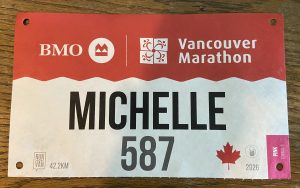
This was a race that should never have happened, based on the training I did. In fact, the training is the interesting part of this story, and the fact that it was such a struggle made the race even more meaningful because I learned something.
Well, a lot of things.
Rewind to January
… when I decided I was going to get strong. Nothing wrong with that; in fact it’s an excellent idea for runners (or anyone) to work out in the gym. But I was a little too enthusiastic, lifting more than I should have and on the day before my long runs, so my hip got a bit sore.
If that was the whole story, I might have taken a week off and been as good as new.
Instead, I had IMS on my hip and lower back. IMS is unpredictable at the best of times. Sometimes it’s great—and I have had great results with it in the past. Sometimes it does nothing. But sometimes it’s disastrous—and this was a disaster. The muscle release caused my lower back and hip to shift out of position. It was incredibly painful and meant no running for nearly a month.
By the middle of February I was starting to feel better, but at that point I’d made the decision not to do the marathon. It wasn’t possible; I’d lost too much time. I started running, tentatively, still struggling with hip pain—though with stops to stretch, it was more manageable. But the most I could run was 5K.
My running partner who had signed up for BMO had also suffered an injury that cost her significant time, and she was now also on the mend. I’m not sure how or when we decided to train for the race, but once I was running again, I became a little more hopeful. Still, I waffled about it. It wasn’t realistic. I probably shouldn’t do it. But I wanted to, and I hate signing up for races and then not showing up.
Finally there came a morning when I realized I needed to make a commitment. My approach up to that point had been more like I’ll kind of try and see if it works out. That brand of wishy-washy thinking is, in a word, bullshit. It never works out. You have to COMMIT. It has to be a “come hell or high water” decision; I know that from Ironman. Anything less won’t fly.
So… we committed and made a plan that we were not at all sure would work.
The plan
One of the biggest dangers with a marathon build is how quickly you increase your distance. You’re only supposed to increase by 10% per week. That 10% doesn’t just apply to total weekly mileage; it also applies to the long run.
It was the beginning of March. The race was in early May. Subtracting two weeks for the taper, it meant we had until mid-April to go from a long run of around 10k to (ideally) around 35k while reserving every third week for recovery. I know some people keep their longest run to 32k, but I am not one of those people. My body needs the dress rehearsal, so 35-37k as a long run is my preference. Somehow, I’d have to get there without re-injuring myself. We needed a way to build that was fast and smart, but when we did the math, it looked impossible.
Enter walking, hiking, aqua-jogging, and other forms of cross-training (swimming, cycling, and weight training). Note that none of these activities are actually running. The plan felt cobbled together and counter-intuitive, but it was all we had—because I knew from previous experience that pushing that 10% only with running was a recipe for disaster.
We topped up every run with walking, particularly the long run. My chiropractor, who is incidentally a sub-3 marathoner, was skeptical when I told him about it. We’d add 2-3km of walking to the end of our runs as a way to safely increase distance. It turned out to be an excellent cool down, but would it really allow us to make the big jumps we needed from one week to the next?
I also incorporated a 5k hike into my weekly training.

BMO is a very hilly course. I needed to build that strength without risking injury. The hike quickly turned into one of my favorite workouts of the week and the results were astounding. This might have been my biggest surprise of the whole experiment. Hiking those steep hills translated into easily running up hills that weren’t quite as steep. Who knew?
Aqua-jogging, one of the most boring activities known to man, also seemed to be pretty effective. And cross-training, which I have never really credited with helping my running, in fact builds both strength and cardiovascular fitness.
I was lucky to have had a significant amount of training under my belt before January. I think that helped. Still, every Sunday that I laced up my shoes for my long run felt like I was playing Russian roulette. Our jumps in distance from one week to the next seemed… risky. Was this the day there’d be a bullet in the chamber?
The longest run before the longest run
By mid-April, I managed a 34k hilly run plus 2k of walking, to give me what felt like a solid longest run. I didn’t exactly feel ready for the race, but I had done everything humanly possible to get there. Either it would work or I’d blow up.
It worked. In fact, I ran a PB—not the race I’d hoped for, but still a hell of a lot better than the race I never thought I’d run. What made me happiest was the last 10k where I had enough left in the tank to increase my pace and finish strong—and without injury.

I cross-train anyway, but from now on I’ll be giving it the credit it deserves. Walking and hiking were great additions to the plan and going forward I’ll be using them in training. However, I hate aqua-jogging, so I’ll only do that under duress.
Finally, I can’t overstate the value of truly committing, making the decision that you’re going to do something no matter what obstacles come up. That might have been the biggest game-changer of all. That, and self-talk. The mental component of marathon running is HUGE. In fact, it’s so huge, it’s a topic for another post.
Thanks for reading! If you liked this post and want to read more of my writing, consider subscribing to my newsletter.
Leave a Reply